What Happened
Over the last few releases the llama.app ecosystem (the community inference/runtime and model loader toolchain) pushed multiple coordinated changes: a new Kimi‑K3 text model with an updated architecture and quantization format, a set of multi‑platform packaging and build updates across CPU/GPU/mobile backends, runtime hardening for LoRA adapters, and several server/refactor improvements to inference threading and message handling.
- Kimi‑K3 model: introduced a hybrid KDA+MLA architecture, routed latent MoE, a new situ activation, MLA output gating, and MXFP4-packed expert blocks that dequantize losslessly in tests; added conversion, loader and chat parsing support plus tests and artifacts for reproducing generation behavior [4].
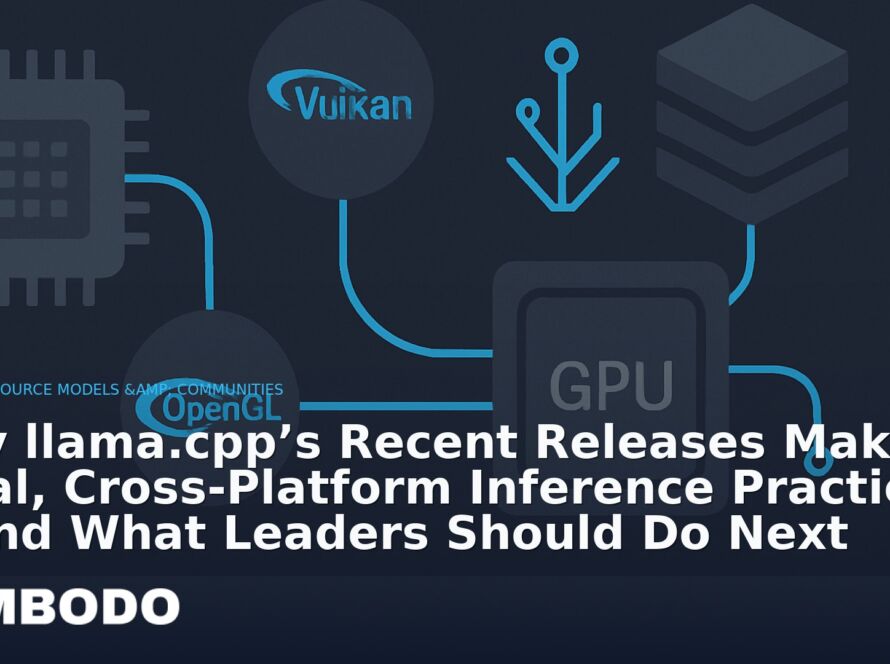
- Packaging and multi‑backend builds: repeated updates to build matrices for macOS (Apple Silicon + Intel), iOS XCFramework, Linux (x64/arm64/s390x), Android arm64, and Windows (x64/arm64) supporting many backends — Vulkan, OpenVINO, SYCL, OpenCL Adreno, and CUDA; several platform/build variants are flagged DISABLED or preview (notably some ROCm and Windows/arm64 CUDA previews) and Windows CUDA builds reference specific CUDA DLL versions [1][2][3][5].
- Runtime safety and robustness: LoRA tensor bounds checking was added to prevent malformed adapter files causing out‑of‑bounds reads; message handling and content‑type detection were refactored and improved; server worker model was redesigned (yield_to_queue) to run speculative processing in worker threads, shifting the worker/main thread interaction [3][2][5].
- Low‑level changes and cleanup: small GGML/concat changes and other refactors to message normalizers and tests were merged to improve loader stability and feature detection [1][2].
Why It Matters to Businesses
These changes reduce friction for production deployments across a wide range of hardware and use cases, while addressing operational and security risks that matter to engineering and product teams.
- Broader deployment surface: tested builds for Apple Silicon, Intel macOS, Linux x64/arm64/s390x, Android and Windows arm64/x64 mean companies can target desktop, server, embedded and mobile without rebuilding core inference code from scratch [1][2][3][5].
- Backend flexibility: support for Vulkan/OpenVINO/SYCL plus CUDA lets teams choose GPU stacks (or fall back to CPU) to optimize cost and latency for their environment — important for on‑prem, edge, and cloud heterogeneity [1][2][5].
- Smaller, verifiable models: MXFP4 quantization with lossless dequantization in tests and the Kimi‑K3 conversion tooling reduce storage and inference memory while preserving output fidelity for many workloads, enabling cheaper inference footprints when validated correctly [4].
- Safer customization: explicit LoRA tensor bounds checking reduces attack surface from malformed adapter files and accidental crashes during dynamic adapter loading — an operational safety win for multi‑tenant or automated adapter pipelines [3].
- Integration readiness: chat format parsing and tool‑call extraction in the Kimi toolchain make it easier to wire models into agent/tooling frameworks and deterministic tool invocation flows [4].
Kimbodo Engineering Perspective
From a production engineering standpoint these upstream changes are useful but introduce trade‑offs that require deliberate decisions.
Trade‑offs
- Many backends = maintenance burden: supporting CUDA, Vulkan, OpenVINO, SYCL, ROCm and multiple CPU ABIs increases CI matrix complexity and long‑term patching cost. Pick a supported subset aligned with your infra and users, not every available target [1][2][5].
- Quantization vs fidelity: MXFP4 and other block quantizations cut memory and bandwidth but must be validated across your prompts and metrics; lossless dequantization in tests is promising, but edge cases can still appear for rare tokens or tool calls [4].
- Feature creep in models: Kimi‑K3’s hybrid MoE/SSM elements and larger LLAMA_MAX_EXPERTS increase model capability but also complicate runtime resource planning, routing logic, and debugging [4].
- Operational safety vs performance: adding bounds checks and stricter message normalization reduces crash risk but can add small CPU overhead; that trade is usually worth it for multi‑tenant services [3][2].
Practical judgment
- Prioritize a narrow set of hardware/backends for initial rollouts (e.g., CUDA x64 for cloud, Apple Silicon for macOS/iOS clients, Vulkan for portable GPUs) and automate fallbacks for unsupported environments [1][2][5].
- Treat adapter loading (LoRA) as an input vector requiring validation, versioning and size limits — never trust unverified adapter files in production [3].
- Require deterministic CI tests that mirror the repo’s end‑to‑end generation tests (content, tool calls, finish reasons) for any converted or quantized model, following the Kimi‑K3 test approach [4].
How We Would Implement It
Below is a concrete architecture and rollout plan Kimbodo would use to adopt these community advances for a production service.
High‑level architecture
- Model artifacts: store canonical GGUF/GGML artifacts (signed, versioned) in an artifact registry. Keep both FP16/FP32 and quantized (MXFP4) variants if required for tiered serving.
- Inference layer: a multi‑backend adapter that selects the runtime (CUDA, Vulkan, OpenVINO, CPU) at startup based on host capabilities. Abstract LoRA injection and Kimi chat parsing behind the adapter API.
- Service layer: containerized model servers with autoscaling groups (GPU and CPU pools) behind a router that supports model routing, tool‑call whitelisting and request quotas.
- CI/CD and tests: automated conversion & smoke tests that reproduce the repo’s generation tests (match logits/finish reasons, tool_calls, streaming deltas) before promoting artifacts to production [4].
Concrete steps
- Audit the build matrix and select supported build targets (e.g., CUDA x64, Apple Silicon arm64, Vulkan x64/arm64). Disable experimental/preview combinations in production (ROCm/Windows arm64 CUDA preview) until upstream stabilizes [1][2][5].
- Integrate the LoRA bounds checks and add file‑format schema validation and size caps before adapter apply; fail closed if validation fails [3].
- Adopt the Kimi chat parsing components (marker detection, per‑role delimiters, tool call parsing) as a shared library for agent integrations; run the provided test fixtures during CI to detect regressions [4].
- Validate quantized artifacts using representative prompts and metrics; include a dequantization check to ensure MXFP4 blocks reproduce FP32 behavior within target tolerances [4].
- Implement the worker‑side speculative processing model (run common_speculative_process in worker threads) to reduce main‑thread stalls; benchmark throughput/latency trade‑offs before enabling globally [5].
- Package and sign platform builds; publish pinned CUDA DLL/driver requirements alongside artifact metadata so deployments can validate host compatibility [1][2].
Risks, Costs and Security
Adopting community models and multi‑backend runtimes brings concrete risks and predictable costs; mitigations are practical but require discipline.
- Build and maintenance cost: supporting many OS/ABI/backend permutations increases CI time, human patching and debugging effort. Mitigation: limit production targets and automate cross‑compilation and smoke tests [1][2][5].
- Dependency brittleness: Windows CUDA builds referencing specific DLL versions, preview ROCm/arm64 CUDA builds and disabled platform entries show upstream fragility. Pin runtime dependencies and validate hosts before deployment [1][5].
- Model integrity and supply chain: quantized and converted artifacts must be checksummed and signed; conversion scripts need unit/acceptance tests to avoid silent corruption [4].
- Adapter and plugin risk: LoRA adapters and third‑party tool call formats can be an attack vector for model injection or data exfiltration; enforce adapter signing, size limits, sandboxed execution and tool‑call whitelists [3][4].
- Performance vs safety: bounds checks and strict parsing slightly increase CPU use but materially reduce crash and exploitation risk — accept small overheads for production safety [3][2].
- Licensing and provenance: community weights and datasets (EA/LAION ecosystem) require due diligence for licensing, training data provenance and regulatory compliance; maintain legal review and provenance metadata for each artifact.
In short: the recent upstream work makes it practical to run contemporary, efficient open models across desktop, cloud and edge, but production adoption should be incremental — pick stable backends, validate quantized artifacts with representative tests, harden adapter loading, and automate signed packaging and host compatibility checks before rolling into customer‑facing services.
Where Kimbodo Comes In
Kimbodo builds and operates this in production for businesses — see our Machine Learning Development practice, or Scope an ML Project.